

If you’ve taken a break from creating—burnout, life, a corporate season, healing, family, any of it—and you’re finally ready to claim your little corner of the internet again… I get it.
What’s different now is the noise.
The “you have to post every day” energy.
The constant platform shifts.
The pressure to stay visible, relevant, and consistent like it’s a full-time sport.
So here’s the adjustment I’m making as I come back: I’m building a workflow that serves my strategy, not a workflow that serves the internet.
And I’m doing it with the 5 W’s.
Not the school essay version—the creator version.
The problem: you don’t need “more content”; you need a smarter workflow
When you’re returning after time away, it’s easy to assume the fix is to do more.
More platforms.
More formats.
More trends.
More research.
But the real issue is usually this: your workflow isn’t connected to a clear strategy, so every content decision feels like starting over.
A smart workflow does two things at once:
- It protects your energy.
- It turns your priorities into repeatable steps.
That’s the goal.
The 5 W method for building a smart workflow
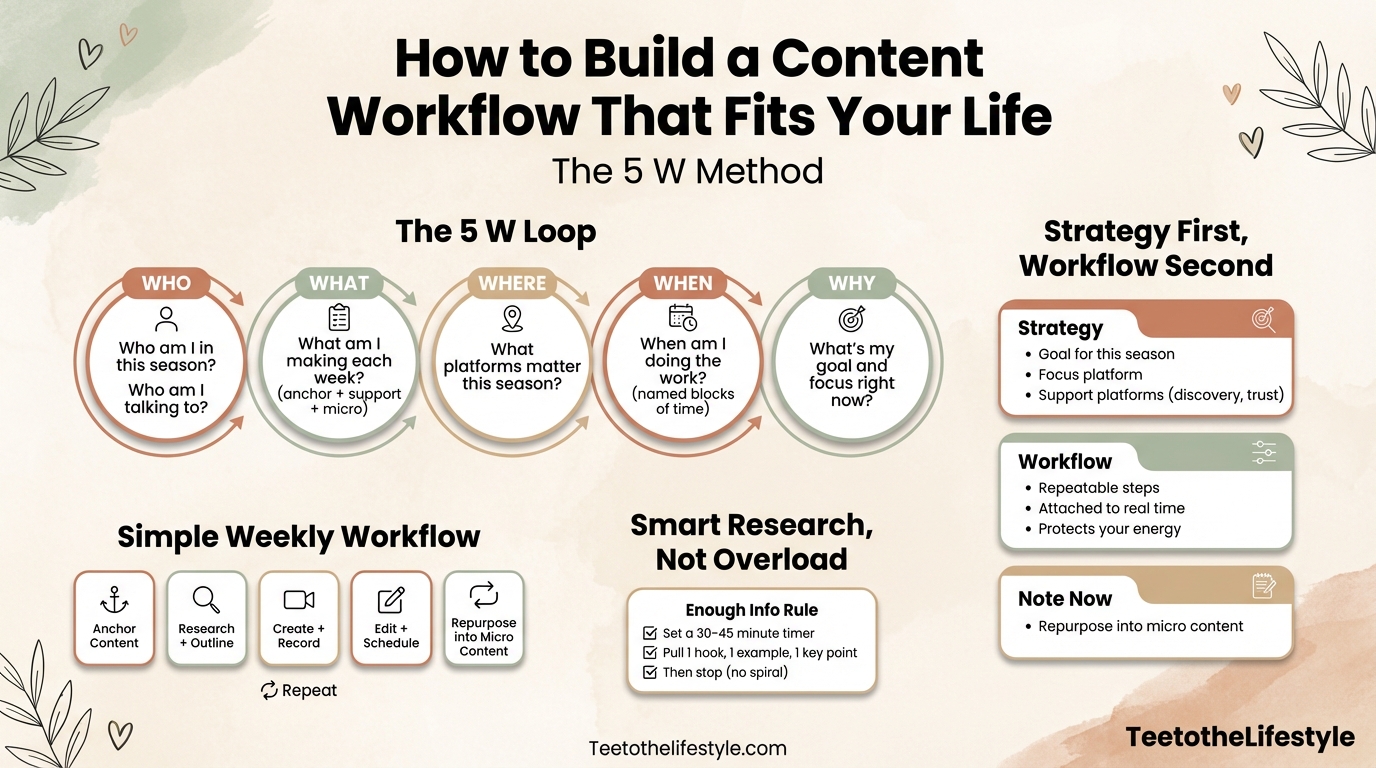
Think of the 5 W’s like your workflow filter.
If your workflow can’t answer these five questions clearly, it’s going to feel heavy.
1) WHO is this workflow for?
Start with you.
Not “the best practices.” Not “what creators are doing.”
Ask:
- Who am I in this season of life?
- What do I realistically have capacity for each week?
- What kind of content can I show up for consistently without resentment?
And then zoom out:
- Who am I talking to?
- What does she actually need from me right now?
Most of the time, your audience is a reflection of your lived experience.
That’s why returning creators have so much power—you’re not guessing. You’ve lived the season.
2) WHAT am I making each week?
This is where you decide your weekly output so you stop negotiating with yourself every day.
For a simple, sustainable setup, pick:
- Your main content (your “anchor”)
- Your support content (what makes the anchor easier to find)
- Your micro content (what keeps you visible between anchor posts)
The key is: don’t pick what’s impressive. Pick what’s repeatable.
If you’re rebuilding, repeatable beats perfect.
3) WHERE am I posting (this season)?
This is the part creators skip—and it’s why everything feels like chaos.
You don’t need to be everywhere.
You need to be where it matters for your goal.
Ask:
- Where does my audience actually spend time?
- Where does my content have the longest life?
- Where do I enjoy showing up?
Then choose your priority platforms for this season.
Example of a simple “where” decision:
- One home base (blog/website or YouTube)
- One community touchpoint (where you talk back and build relationship)
- One discovery channel (where new people find you)
Pick your mix based on your real life—not someone else’s highlight reel.
4) WHEN am I doing the work?
A workflow is only real when it’s attached to time.
Instead of “I’ll work on it sometime,” decide:
- What day am I researching?
- What day am I writing?
- What day am I recording?
- What day am I scheduling?
Even if the blocks are small, having them named matters.
Because when your brain is tired, a named block is a decision you don’t have to re-make.
5) WHY am I doing it this way?
This is where your strategy lives.
Ask:
- What is my goal right now?
- What is my focus?
- What is the pivot I’m making in this season?
Your “why” keeps you from chasing every trend.
It’s the difference between being informed and being overwhelmed.
If you don’t define your why, the algorithm will define it for you.
How to align your workflow with strategy (without getting overwhelmed)
Here’s the simple rule I’m using: strategy first, workflow second.
Step 1: Decide the goal for this season
Examples:
- Grow email list
- Build YouTube consistency
- Rebuild brand trust after a break
- Relaunch an offer
- Get back into a weekly rhythm
Pick one primary goal.
If everything is the goal, nothing is the goal.
Step 2: Choose 1 main focus platform
Your focus platform is where your best effort goes.
It’s where you’re building the habit again.
This matters because if you split your effort across too many places while you’re rebuilding, you’ll burn out trying to “keep up” again.
Step 3: Choose support platforms on purpose
Support platforms have a job.
Not a vibe.
Examples of “jobs” a platform can have:
- Discovery (new people find you)
- Trust (people stay with you)
- Community (people talk back)
- Search (people find you weeks later)
Step 4: Build a workflow that matches your PSP
Your PSP (Problem → Solution → Promise) is not just for the content.
It can be the backbone of your workflow too.
Ask:
- What problem am I helping her solve this week?
- What solution am I sharing?
- What promise am I making (what changes for her)?
When your workflow is built around clarity, you stop creating “random.”
And your audience feels that.
Research without overload: the “enough info” rule
You do need research.
You do not need an internet spiral.
Try this:
- Set a timer (30–45 minutes).
- Pull only what you need:
- one hook idea
- one supporting example
- one key point you want to teach
- Then stop.
A smart workflow protects you from over-researching as procrastination.
Because we all do it.
The pivot: keep it simple and stay open to adjusting
Your workflow doesn’t need to be permanent.
It needs to be usable.
You’re allowed to:
- simplify
- test
- adjust
- repeat
That’s not inconsistency.
That’s you building a workflow that respects your life.
Quick checklist: build your “smart workflow” in 10 minutes
- WHO: Who am I in this season? Who am I talking to?
- WHAT: What am I making each week? (anchor + support + micro)
- WHERE: What platforms matter this season, and why?
- WHEN: What days am I doing the work?
- WHY: What’s my goal and focus right now?
The takeaway
If you’re coming back after a break, you don’t need to sprint back into the rat race.
You need a workflow that helps you rebuild momentum on purpose.
Start simple.
Start clear.
And let your workflow grow with you.
Before you go
Before you build a workflow, you’ve gotta answer this first: how are you showing up in this season?
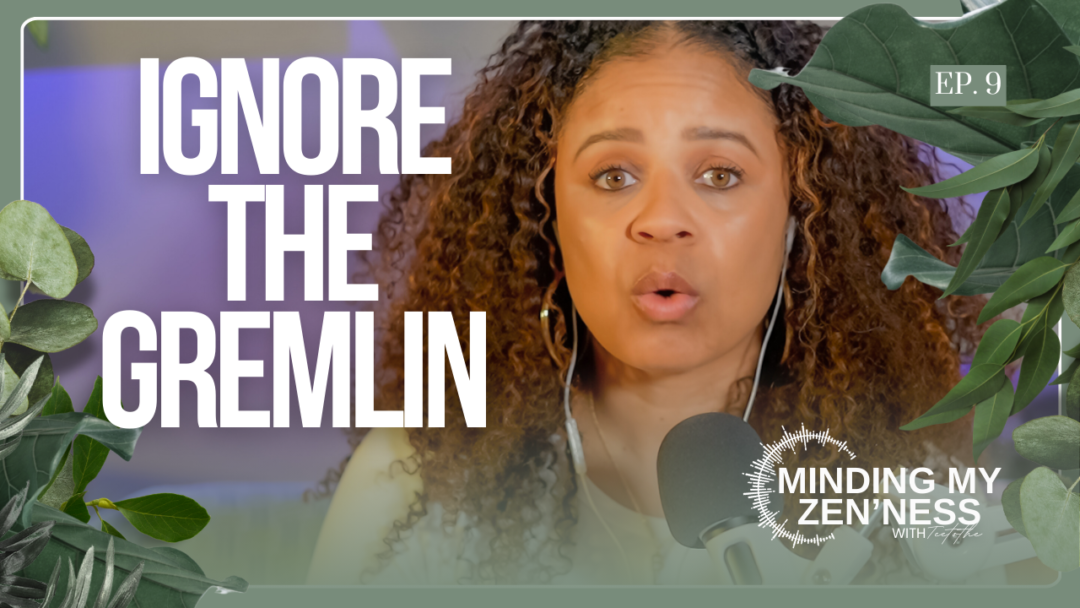
Because I’m not trying to force a “perfect creator routine” anymore. I recently shared the shifts I’m making—what I’m prioritizing, what I’m letting go of, and how I’m rebuilding my rhythm without trying to keep up with everything.
If you’re in that same “I’m coming back, but I want to do it smarter” season, come hang out with me!








 ©2026
©2026 )